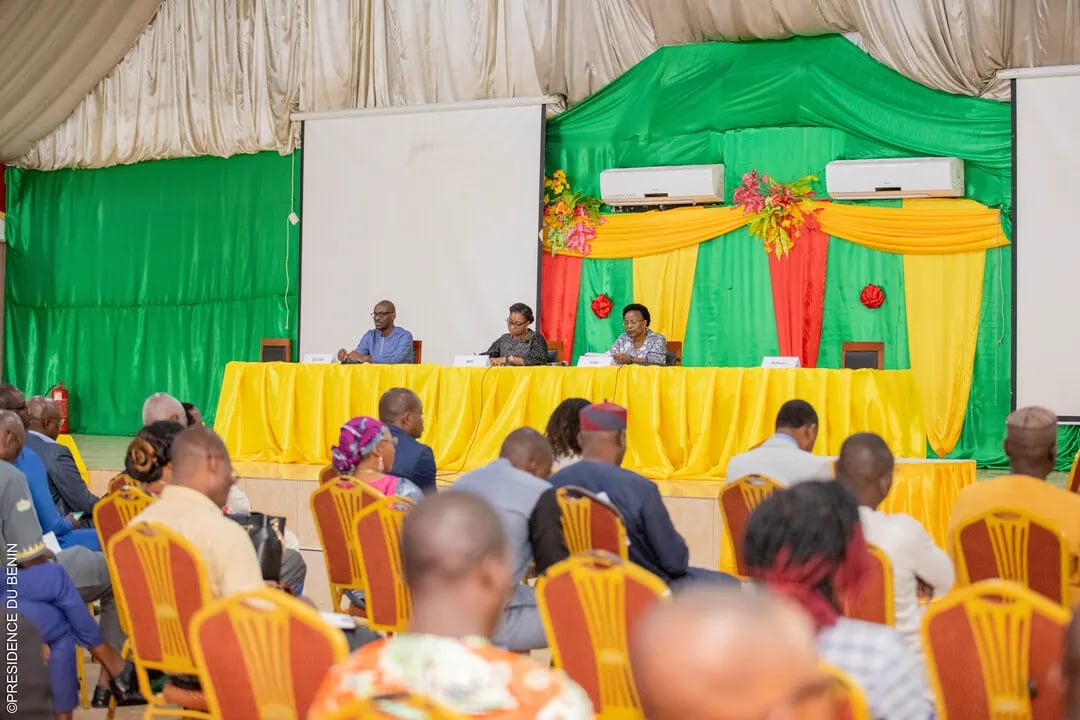
On Thursday 30 June 2022, the Minister of Digital Affairs and Digitalisation, Ms Aurelie ADAM SOULE ZOUMAROU, and her colleague the Minister of Higher Education and Scientific Research, Ms Eléonore YAYI LADEKAN, officially brought the Benin Education and Research Network (RBER) into service on the campus of the University of Abomey-Calavi. This took place at a ceremony attended by a large number of members of the university community.
On Thursday 30 June 2022, the Minister of Digital Affairs and Digitalisation, Ms Aurelie ADAM SOULE ZOUMAROU, and her colleague the Minister of Higher Education and Scientific Research, Ms Eléonore YAYI LADEKAN, officially brought the Benin Education and Research Network (RBER) into service on the campus of the University of Abomey-Calavi. This took place at a ceremony attended by a large number of members of the university community.
The RBER aims to develop the use of digital technology and human capacity in the education sector and in professional, technical, initial and continuing training. Specifically, it will provide digital services to students, academic staff and university administrative departments by building a network interconnecting universities and research centres, and will stimulate innovation from higher education. Ten university sites were interconnected during the implementation of the first phase of the project. Mr Marc-André LOKO, Director General of the Information Systems and Digital Agency (ASIN), the body that carried out the project under the supervision of the Ministry of Digital Affairs and Digitalisation, welcomed the completion of the project, which brings services such as connectivity, videoconferencing and IP telephony to the Abomey-Calavi university campus. The works carried out on the campus of the University of Abomey-Calavi under the RBER are as follows:
- The construction of a campus network of 420 access points, spread across lecture theatres, laboratories and administrative offices;
- The installation of two videoconferencing and IP telephony systems;
- An internet speed of 1,000 Mbps;
- The renovation and upgrading to standard of the UAC server room
- The deployment of 7,000 metres of optical fibre
The Minister of Higher Education and Scientific Research, Ms Eléonore YAYI LADEKAN, invited the entire UAC university community to take up this tool and make proper use of it. “The RBER will provide access to the internet, documentation, online courses and knowledge in general,” she explained. Ms Nelly KELOME, Vice-Rector in charge of international cooperation at UAC, speaking on behalf of the Rector of UAC, thanked the Government for this tool, which will enhance the quality of teaching and research at the university.
“The RBER is today the largest fixed network in Benin,” said the Minister of Digital Affairs and Digitalisation, Ms Aurelie ADAM SOULE ZOUMAROU, before adding that “the RBER is not just about the internet. It is first and foremost a network that interconnects all university sites and enables the sharing of digital resources and educational resources, as well as mobility between the various sites while continuing to benefit from the same services”. She also added that the second phase of the project will include new services and cover new university sites.
The ten university sites covered by the first phase of the RBER are: the Faculty of Health Sciences (FSS) in Cotonou; the National School of Applied Economics and Management (ENEAM); the École Normale Supérieure (ENS) in Porto-Novo; the Institute of Mathematics and Physical Sciences (IMSP) in Dangbo; the National University of Agriculture (UNA) in Kétou; the National University of Sciences, Technologies, Engineering and Mathematics (UNSTIM) in Abomey; the National Higher School of Applied Biosciences and Biotechnologies (ENSBBA) in Dassa-Zoumé; the École Normale Supérieure (ENS/FAST) in Natitingou; the University of Parakou (UP); and the University of Abomey-Calavi (UAC).