
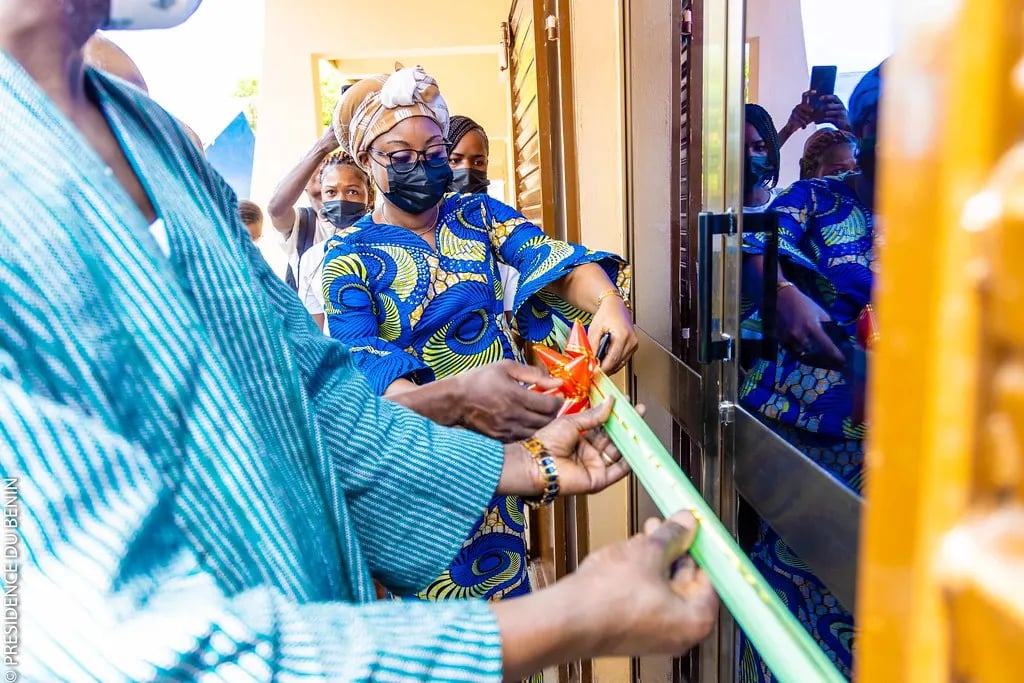
Continuing to give concrete form to its vision of “positioning Benin as the digital services platform of West Africa to accelerate growth and social inclusion”, the Government of the Republic of Benin, through the digital and digitalisation, higher education and scientific research, and social affairs and microfinance sectors, commissioned two digital classrooms in the city of Parakou on Thursday 10 March 2022: the digital classroom of the University Institute of Technology of Parakou and that of the Social Promotion Centre for the Blind (CPSA).
Chaired by Mrs Aurelie ADAM SOULE ZOUMAROU, Minister of Digital Affairs and Digitalisation, the ceremony commissioning the digital classroom of the IUT of Parakou, located at the heart of the KOBOUROU City Campus, was held in the presence of the university community (students, lecturers, members of the rectorate); Mr Inoussa ZIME CHABI, Mayor of Parakou; the Secretary General of the Parakou Prefecture, Mr SANNI BIO BAYE; the representative of the Rector of the University of Parakou, Mr Henry TCHOKPONHOUE; Mr François De Paule AGOUA, Director General of the Beninese Agency for Universal Service in Electronic Communications and Postal Services; Mr Alexis BOTON, Director of the CPSA; and the Borgou Departmental Director of Social Affairs and Microfinance, Mr Bakourégui SUANON.
The commissioning of this flagship facility is part of the delivery of the flagship project “Generalising digital use through education and training” of the Government Action Programmes I and II.
Built by the Beninese Agency for Universal Service in Electronic Communications and Postal Services (ABSU-CEP) under the supervision of the Ministry of Digital Affairs and Digitalisation, the digital classroom of the IUT of Parakou is a 15 m by 8 m prefabricated building equipped with: 60 “student” laptops on a wireless network, each with an anti-theft lock; 1 “teacher” laptop with anti-theft lock; 1 interactive whiteboard with video projector; 1 magnetic whiteboard and marker holder; a storage and charging cabinet (trolley) with a total capacity of at least 61 laptops; a router/access point (AP) for the Wi-Fi network and internet access; 61 sets of student furniture consisting of tables and chairs; a properly sized solar power system to supply all the installations for 48 hours without interruption; classroom management software; digital teaching content; 2 wireless cameras inside the building connected to a 32-inch TV screen in the director’s office; a videoconferencing kit (1 Polycom RealPresence Group 500 pack); a NAS storage server, etc.
On this occasion, Mrs Aurelie ADAM SOULE ZOUMAROU recalled some of the digital projects delivered by the Government since 2016: the commissioning of the Beninese Education and Research Network (RBER); the digital platforms PEUPL and e-résultats.bj; and the digital classrooms built across the national territory, namely 12 in nursery and primary education, 12 in secondary education and technical and vocational training, and the ENEAM digital classroom. She also thanked all the members of the Government and the stakeholders for their involvement in implementing the digital projects and invited the beneficiaries to make good use of this flagship facility to learn and put themselves on a par with all the major universities “we hear about in other parts of the world.”
After the IUT of Parakou, the ministerial delegation then headed to the Social Promotion Centre for the Blind (CPSA) in Parakou, where the ceremony commissioning the digital classroom for people with visual impairments took place.
The classroom is equipped with ten or so desktop computers (All-in-One) on a wireless network, 09 of them for learners and 1 for the teacher; 10 laptops with specialised software for students affiliated with the centre; a magnifying television; two (2) reading machines; ten noise-cancelling headsets; a NAS storage server; a Braille printer; ten Braille displays; ten programmable keyboards; a Wi-Fi router/access point; a solar power supply system; and digital content.
Each commissioning ceremony ended with a ribbon-cutting, a tour of the classrooms and a demonstration of the use of the digital tools by the beneficiaries.